
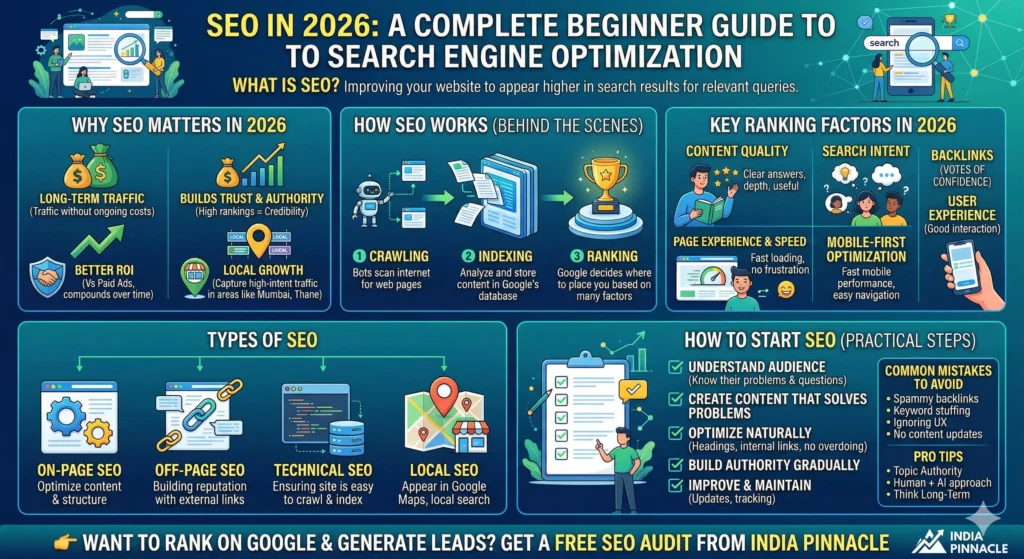
Search Engine Optimisation (SEO) is the process of improving your website so that it appears higher in search results when users search for relevant queries.
Introduction
Launching a website today is easier than ever. But getting people to actually visit that website? That’s where most businesses struggle.
You might have a well-designed site, great services, and competitive pricing — but if your website isn’t appearing on Google when people search, you’re essentially invisible. This is exactly the problem that Search Engine Optimization (SEO) solves.
In 2026, SEO is no longer just about inserting keywords or building random backlinks. It has evolved into a sophisticated system that focuses on user intent, content quality, authority, and experience. Google’s algorithms are smarter, users are more demanding, and competition is higher than ever.
This guide will help you understand SEO from the ground up — not just what it is, but how it actually works and how you can start using it to grow your business.
What is SEO?
Search Engine Optimization (SEO) is the process of improving your website so that it appears higher in search engine results when users search for relevant queries.
But to truly understand SEO, you need to go beyond the definition.
SEO is about connecting your content with the exact moment someone is searching for it.
For example, when a user types “best SEO agency in India,” they are not just browsing — they are actively looking for a service. If your website appears at that moment, you are capturing highly valuable traffic with strong intent.
This is what makes SEO powerful:
- It targets users already interested
- It brings organic (free) traffic
- It compounds over time
In essence, SEO is the bridge between your website and your audience.
Why SEO is Important in 2026
Many businesses still treat SEO as optional or secondary. In reality, it has become one of the most critical components of digital growth.
Long-Term Traffic Without Ongoing Costs
Unlike paid advertising, where traffic stops the moment you stop spending, SEO works differently. Once your content ranks well, it can continue attracting visitors consistently over time.
This creates a compounding effect. A single well-optimized article can bring in traffic for months or even years, reducing your dependence on paid campaigns.
Trust is Built Through Visibility
Users inherently trust search engines. When your website appears at the top of search results, it signals credibility.
People often associate higher rankings with:
- Expertise
- Authority
- Reliability
This psychological factor plays a huge role in decision-making, especially for service-based businesses.
Better ROI Compared to Paid Marketing
SEO requires effort and time, especially in the beginning. However, once it gains traction, the cost per lead becomes significantly lower than paid ads.
Instead of paying for every click, you invest in building assets (content, backlinks, authority) that continue to generate returns.
Critical for Local Businesses
For businesses targeting specific locations like Mumbai or Thane, SEO becomes even more powerful through local optimization.
When someone searches for:
- “SEO agency near me”
- “digital marketing services in Mumbai”
They are ready to take action. Ranking for these queries means capturing high-conversion traffic.
How SEO Works (Behind the Scenes)
To understand SEO properly, you need to understand how search engines operate.
Search engines like Google follow three primary steps:
1. Crawling: Discovering Your Website
Google uses bots (also called crawlers or spiders) to scan the internet and discover web pages. These bots move from link to link, collecting data about your site.
If your website is poorly structured or lacks internal links, these bots may struggle to find your content.
2. Indexing: Storing Information
Once your page is discovered, Google analyzes and stores it in its database (index). This includes:
- Content
- Keywords
- Media
- Structure
If your page isn’t indexed, it won’t appear in search results at all.
3. Ranking: Deciding Where You Appear
This is where competition comes in. Google evaluates your page against thousands of others and decides where it should rank.
This decision is based on multiple factors, including:
- Relevance to the query
- Content quality
- Authority
- User experience
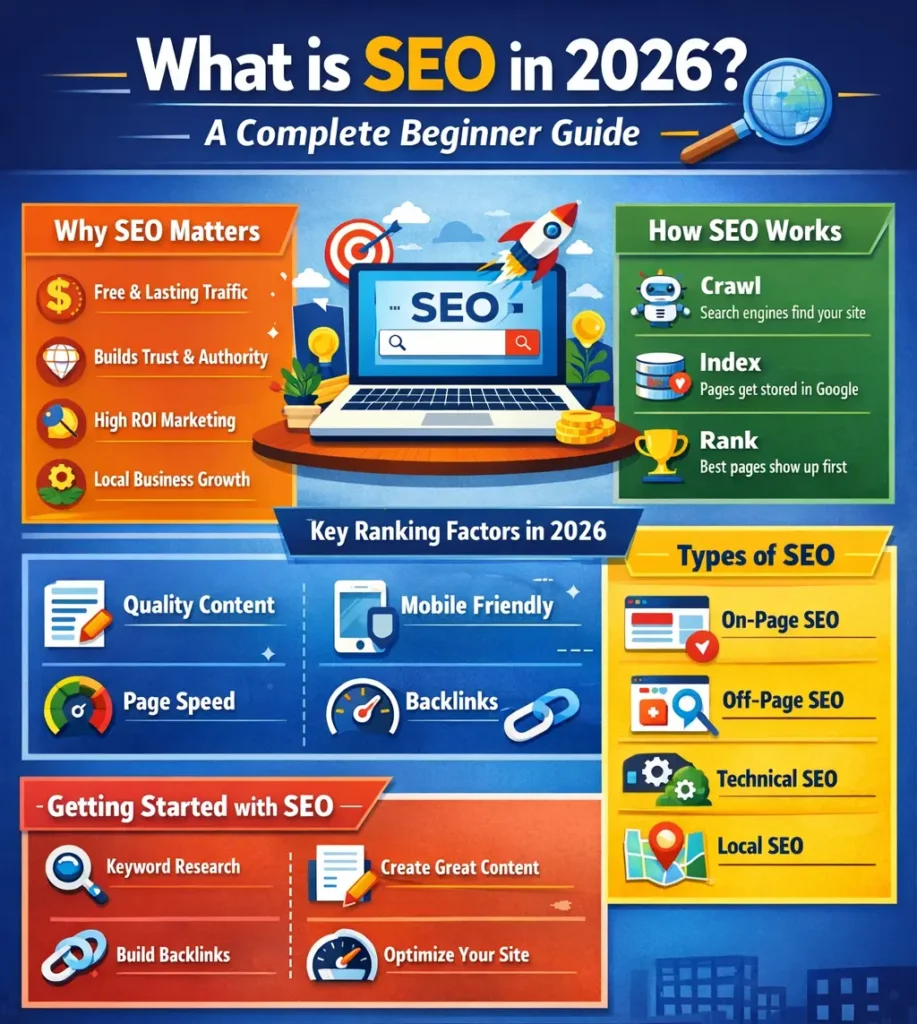
Key Ranking Factors in 2026 (Explained Deeply)
Content Quality: The Core of SEO
Content is no longer about length — it’s about usefulness.
Google prioritizes content that:
- Answers the user’s query clearly
- Provides depth and context
- Is easy to read and structured
Thin or generic content will not survive in modern SEO. Your goal should be to create content that genuinely helps the user, not just content that tries to rank.
Search Intent: The Most Important Factor
Understanding why someone is searching is more important than what they are searching.
For example:
- “What is SEO” → user wants knowledge
- “SEO services India” → user wants to hire
If your content doesn’t match the intent, it won’t rank — even if it’s well written.
Page Experience and Speed
Users expect websites to load instantly. A slow website creates frustration and increases bounce rates.
Google tracks this behavior. If users leave quickly, it signals poor experience, which negatively impacts rankings.
Mobile-First Optimization
Most users today access websites through mobile devices. Google now evaluates websites based on their mobile performance first.
This means your website must:
- Load fast on mobile
- Be easy to navigate
- Have readable content
Backlinks: Building Authority
Backlinks are essentially votes of confidence from other websites.
However, not all backlinks are equal. A few high-quality backlinks from authoritative sites are far more valuable than hundreds of low-quality ones.
Backlinks help Google understand that your website is trustworthy and worth ranking.
User Experience (UX)
SEO is no longer just technical — it’s behavioral.
Google analyzes how users interact with your site:
- Do they stay and read?
- Do they click on other pages?
- Do they return to search results quickly?
Good UX improves engagement, which directly influences rankings.
Types of SEO (With Real Understanding)
There are 4 major types of SEO
On-Page SEO
This is where everything begins. On-page SEO involves optimizing the content and structure of your website.
It’s not just about inserting keywords — it’s about:
- Structuring content properly
- Making it readable
- Ensuring clarity
Think of on-page SEO as making your content understandable for both users and search engines.
Off-Page SEO
Off-page SEO focuses on building your website’s reputation.
When other websites link to you, it signals that your content is valuable. This increases your authority and improves your chances of ranking higher.
It’s similar to word-of-mouth in the digital world.
Technical SEO
Technical SEO ensures that your website is easy for search engines to crawl and understand.
Even great content won’t rank if:
- Your site is slow
- Pages are not indexed
- There are technical errors
This is the foundation that supports everything else.
Local SEO
Local SEO is essential for businesses targeting specific geographic areas.
It helps your business appear in:
- Google Maps
- Local search results
This is especially powerful for service-based businesses that rely on local clients.
How to Start SEO (Practical Approach)
Starting SEO can feel overwhelming, but it becomes manageable when broken down into steps.
Step 1: Understand What People Are Searching
SEO starts with understanding your audience. You need to know:
- What problems they have
- What questions they ask
- What solutions they are looking for
This is where keyword research comes in.
Step 2: Create Content That Solves Problems
Instead of writing for search engines, write for people.
Ask yourself:
“Does this content actually help someone?”
If the answer is yes, you’re on the right track.
Step 3: Optimize Without Overdoing It
Use keywords naturally. Structure your content with headings. Add internal links.
But avoid over-optimization — it often does more harm than good.
Step 4: Build Authority Gradually
Start building backlinks through:
- Guest posts
- Content sharing
- Strategic platforms
Focus on quality over quantity.
Step 5: Improve and Maintain
SEO is not a one-time activity. It requires:
- Regular updates
- Performance tracking
- Continuous improvement
Common Mistakes to Avoid
Many beginners make the mistake of focusing on shortcuts.
- Trying to rank quickly using spammy backlinks
- Writing content only for keywords
- Ignoring user experience
- Not updating content
These mistakes can delay or even damage your progress.
Pro Tips That Make a Real Difference
Instead of chasing isolated keywords, focus on building topic authority. Cover a subject deeply with multiple interconnected articles.
Combine AI tools with human insight to scale content without losing quality.
And most importantly, think long-term. SEO rewards consistency, not shortcuts.
Conclusion
SEO in 2026 is a combination of strategy, content, and experience. It’s not about tricking search engines — it’s about aligning with them.
If you focus on creating value, understanding your audience, and building authority over time, SEO can become your most powerful growth channel.
Want to rank your website on Google and generate real leads?