
How Search Engines Work: Crawling, Indexing, and Ranking Explained
Introduction
Whenever you search for something on Google, you get thousands of results in a fraction of a second. But have you ever wondered how search engines decide which pages to show and in what order?
Understanding how search engines work is one of the most important foundations of SEO. Without this knowledge, optimizing your website becomes guesswork. Once you understand the process behind crawling, indexing, and ranking, you can align your strategy with how search engines actually evaluate content.
In 2026, search engines have become incredibly advanced. They don’t just scan pages — they interpret meaning, evaluate user behavior, and prioritize content that truly satisfies search intent.
This guide will help you understand how search engines work in a clear and practical way so you can apply it directly to your website.
Quick Overview: How Search Engines Work
If you want a simplified view, here’s how search engines work:
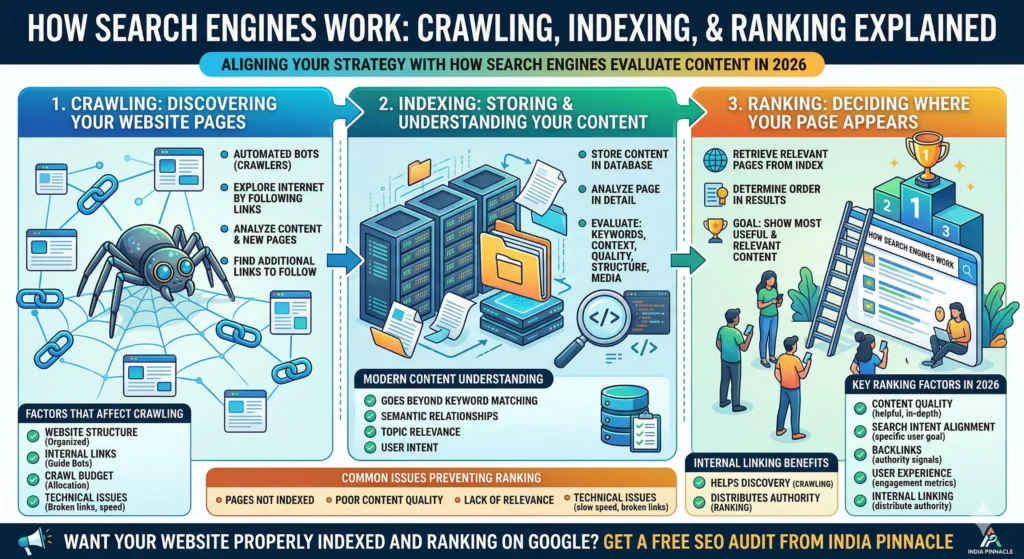
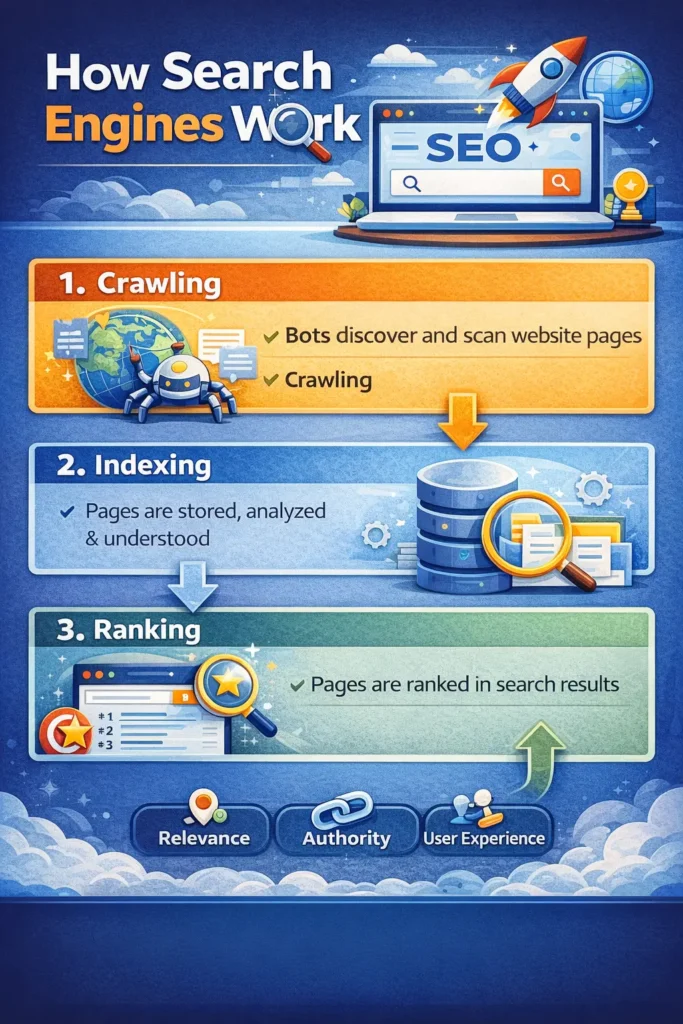
- Crawling → Discovering your website pages
- Indexing → Storing and understanding your content
- Ranking → Deciding where your page appears in search results
These three stages form the backbone of every search engine.
What is Crawling and How It Works
Crawling is the first step in how search engines work. It is the process through which search engines discover new and updated web pages.
Search engines use automated bots, often referred to as crawlers or spiders, to explore the internet. These bots move from one page to another by following links. Every time they land on a page, they analyze its content and look for additional links to follow.
If your website is well-structured and properly linked, these bots can easily navigate through your pages. However, if your site lacks internal linking or has broken paths, some pages may remain undiscovered.
Crawling is not just about finding pages — it is about accessibility. If search engines cannot access your content, it simply does not exist for them.
Factors That Affect Crawling
Several factors influence how efficiently search engines crawl your website.
One of the most important factors is your website structure. A clean and organized structure makes it easier for crawlers to navigate your site. Internal links play a crucial role here, as they guide bots from one page to another.
Another factor is crawl budget. Search engines allocate a certain amount of resources to crawl your site. If your website has too many low-value pages or duplicate content, it can waste this budget and prevent important pages from being crawled.
Technical issues such as broken links, slow loading times, or blocked pages can also negatively impact crawling.
What is Indexing and Why It Matters
Once a page is discovered through crawling, the next step is indexing.
Indexing is the process of storing and organizing your content in a search engine’s database. During this stage, search engines analyze your page in detail to understand what it is about.
They evaluate:
- Keywords and context
- Content quality
- Structure
- Media elements
If your page meets the required standards, it gets added to the index. Only indexed pages are eligible to appear in search results.
If your page is not indexed, it does not matter how optimized it is — it simply won’t rank.
How Search Engines Understand Content
Modern search engines go beyond simple keyword matching. They use advanced algorithms to understand the meaning behind your content.
This includes analyzing:
- Topic relevance
- Semantic relationships between words
- User intent
For example, if your page talks about “on-page SEO checklist,” search engines also expect related concepts like content optimization, internal linking, and keyword placement.
This is why creating comprehensive content is essential.
What is Ranking and How It Works
Ranking is the final stage in how search engines work. This is where search engines decide the order in which pages appear in search results.
When a user enters a query, search engines scan their index and retrieve the most relevant pages. These pages are then ranked based on multiple factors.
The goal is simple: show the most useful and relevant content at the top.
Key Ranking Factors in 2026
Ranking is influenced by a combination of factors working together.
Content quality remains the most important factor. Pages that provide clear, helpful, and in-depth information are more likely to rank higher.
Search intent alignment is equally critical. If your content does not match what the user is looking for, it will struggle to perform.
Backlinks act as authority signals, indicating that your content is trusted by other websites.
User experience also plays a major role. Metrics such as time on page, bounce rate, and engagement help search engines evaluate how users interact with your content.
The Role of Search Intent in Ranking
Search intent is one of the most important concepts in modern SEO.
When someone searches for a query, they have a specific goal. It could be to learn something, compare options, or make a purchase.
Search engines analyze this intent and prioritize content that best satisfies it.
For example, a search for “how search engines work” requires informational content. If your page tries to sell a service instead, it will not rank well.
Understanding intent allows you to create content that aligns with what users actually want.
How Internal Linking Supports Crawling and Ranking
Internal linking connects your content and plays a vital role in how search engines work.
From a crawling perspective, internal links help search engines discover new pages. From a ranking perspective, they distribute authority across your site.
When you link related pages together, you create a structured network of content. This strengthens your topical authority and improves overall visibility.
Common Issues That Prevent Pages from Ranking
Even if you understand how search engines work, certain issues can prevent your pages from performing well.
Pages that are not properly indexed will never appear in search results. Poor content quality or lack of relevance can also limit rankings.
Technical issues such as slow loading speeds or broken links can negatively impact both crawling and user experience.
Fixing these issues is essential for improving your SEO performance.
Conclusion
Understanding how search engines work is the foundation of every successful SEO strategy. From crawling to indexing to ranking, each stage plays a crucial role in determining your visibility. When you align your website with these processes, you make it easier for search engines to understand and rank your content. Instead of trying to outsmart search engines, focus on working with them. Create valuable content, maintain a strong structure, and ensure a smooth user experienceThis approach will always lead to better results.
FAQs
How do search engines work in simple terms?
They discover pages (crawl), store them (index), and rank them based on relevance.
Why is indexing important?
Only indexed pages can appear in search results.
How long does it take for Google to index a page?
It can take a few hours to several days depending on your website.