
Introduction
If your website isn’t ranking on Google, the problem is often not your strategy — it’s your execution. Most websites fail because they miss the fundamentals, and that’s exactly where an on-page SEO checklist becomes critical.
In 2026, SEO is no longer about tricks or shortcuts. Search engines evaluate how well your page satisfies user intent, how clearly it is structured, and how valuable the content is. This means your pages must be optimized not just for algorithms, but for real users.
This guide is designed to give you both — a quick actionable checklist and a deep understanding of how on-page SEO actually works.
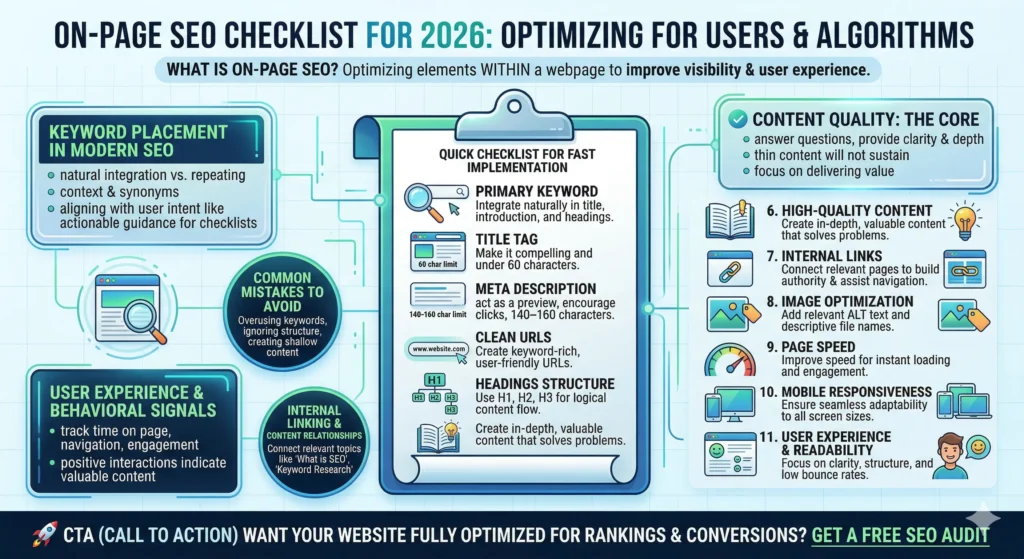
Quick On-Page SEO Checklist (For Fast Implementation)
If you want a quick overview, here’s the complete on-page SEO checklist you can follow:
- Use your primary keyword naturally (title, intro, headings)
- Write a compelling title tag (under 60 characters)
- Optimize meta description (140–160 characters)
- Use clean, keyword-rich URLs
- Structure content with proper headings (H1, H2, H3)
- Create high-quality, in-depth content
- Add internal links to relevant pages
- Optimize images with ALT text
- Improve page speed
- Ensure mobile responsiveness
- Focus on user experience and readability
This checklist gives you the framework, but understanding why each step matters is what will help you rank consistently.
What is On-Page SEO and Why It Matters
On-page SEO refers to optimizing elements within your webpage so that search engines can understand your content and rank it appropriately.
Unlike off-page SEO, which depends on external signals like backlinks, on-page SEO is fully within your control. It determines how clearly your page communicates its purpose to both users and search engines.
When you follow a proper on-page SEO checklist, you’re not just optimizing for rankings — you’re improving clarity, usability, and engagement. These factors directly influence how search engines evaluate your content.
Understanding Keyword Placement in Modern SEO
One of the most important elements of any on-page SEO checklist is keyword placement. However, the way keywords are used today is very different from earlier SEO practices.
Instead of repeating the keyword excessively, the focus is now on natural integration. Search engines are capable of understanding context, synonyms, and related phrases.
Placing your keyword strategically in the title, introduction, and headings helps establish relevance. But what truly matters is how well your content aligns with the user’s intent behind that keyword.
For example, someone searching for an “on-page SEO checklist” is looking for actionable guidance. If your content delivers clarity and depth, it will naturally perform better.
The Importance of Titles and Click Behavior
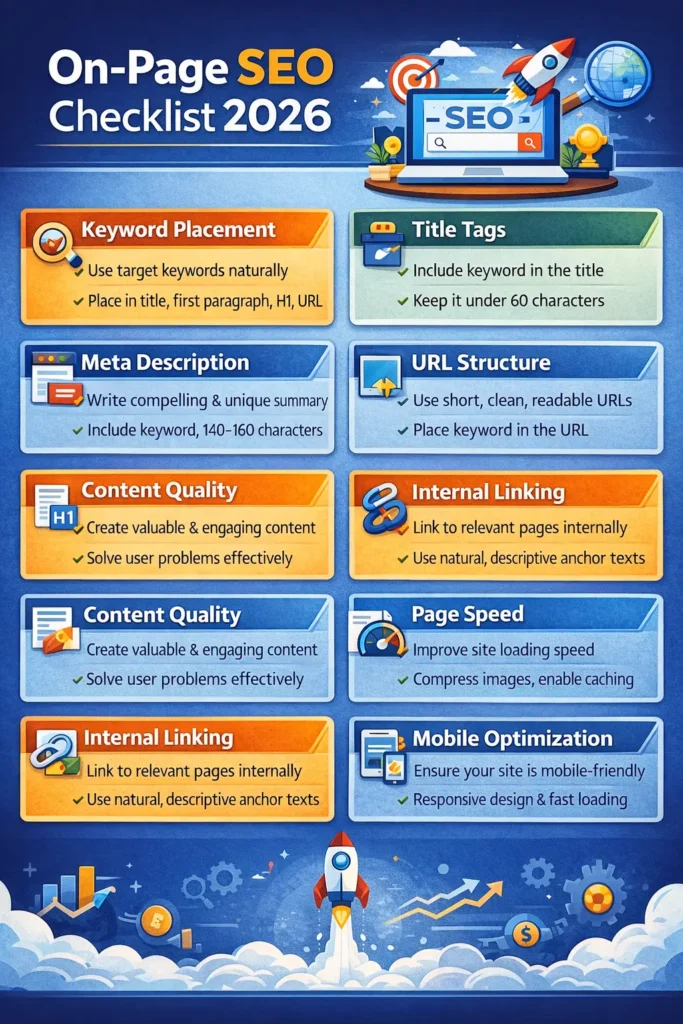
Your title is more than just a heading — it is your first impression on search engines.
A well-crafted title should clearly communicate what the page is about while also encouraging users to click. Including the keyword in the title helps with relevance, but adding elements like the current year or power words can improve click-through rates.
Higher click-through rates send positive signals to search engines, reinforcing your page’s relevance.
Meta Descriptions and Their Role in SEO
Although meta descriptions are not a direct ranking factor, they play a crucial role in user behavior.
A well-written meta description acts as a preview of your content. It should clearly explain what the user can expect while subtly encouraging them to click.
When more users choose your page over others, it improves your overall performance in search results.
Structuring Content for Better Understanding
Content structure is a critical but often overlooked part of on-page SEO.
Using headings properly helps both users and search engines navigate your content. It creates a logical hierarchy, making it easier to understand the flow of information.
Well-structured content also improves readability, which increases engagement and reduces bounce rates.
Content Quality: The Core of Every SEO Strategy
At the heart of every successful on-page SEO checklist is content quality.
Search engines prioritize content that genuinely helps users. This means your content should not only answer questions but also provide clarity, depth, and actionable insights.
Thin or generic content may rank temporarily, but it will not sustain long-term performance.
Internal Linking and Content Relationships
Internal linking is a powerful strategy that connects your content and builds authority.
When you link related pages together, you help search engines understand your website structure. It also allows users to explore more content, increasing their time on your site.
For example, this page should link to your “What is SEO” guide and future blogs like keyword research or technical SEO.
Image Optimization and Performance
Images enhance user experience, but they must be optimized properly.
Search engines rely on ALT text and file names to understand images. Including relevant descriptions improves accessibility and SEO.
At the same time, optimizing image size ensures faster loading speeds, which directly impacts user experience.
Page Speed and Its Impact on Rankings
Speed is no longer optional. Users expect pages to load instantly, and search engines consider this when ranking content.
A slow website leads to higher bounce rates, which signals poor user experience. Improving speed through optimization techniques ensures better performance and higher engagement.
Mobile Optimization as a Ranking Factor
With the majority of users accessing websites through mobile devices, mobile optimization has become a priority.
Your website must adapt seamlessly to different screen sizes while maintaining readability and usability.
A mobile-friendly design improves both user satisfaction and search visibility.
User Experience and Behavioral Signals
Modern SEO is heavily influenced by how users interact with your content.
Search engines track behavior such as time spent on the page, navigation patterns, and engagement levels. Positive interactions indicate that your content is valuable.
Improving user experience through clarity, structure, and relevance strengthens these signals.
Common Mistakes That Limit Rankings
Even with a solid on-page SEO checklist, certain mistakes can hold your website back.
Overusing keywords, ignoring structure, and creating shallow content are common issues. Similarly, failing to update content or neglecting internal linking can weaken your SEO performance.
Avoiding these mistakes is essential for long-term success.
Conclusion
An effective on-page SEO checklist is not just about following steps — it is about building a system where every element of your page works together.
From keyword placement to content quality to user experience, each factor contributes to your overall performance. When combined, they create a strong foundation for sustainable rankings.
Instead of focusing on shortcuts, focus on delivering value and clarity. This approach will always win in the long run.
FAQs
What is an on-page SEO checklist?
It is a structured list of optimizations used to improve a webpage’s ranking on search engines.
How often should I update on-page SEO?
Regular updates every few months help maintain rankings and relevance.
Is on-page SEO enough to rank?
For low-competition keywords, yes. For competitive niches, it must be combined with off-page SEO.
Want your website fully optimised for rankings and conversions?