Author: india pinnacle

  • Key SEO Ranking Factors in 2026

    Key SEO Ranking Factors in 2026

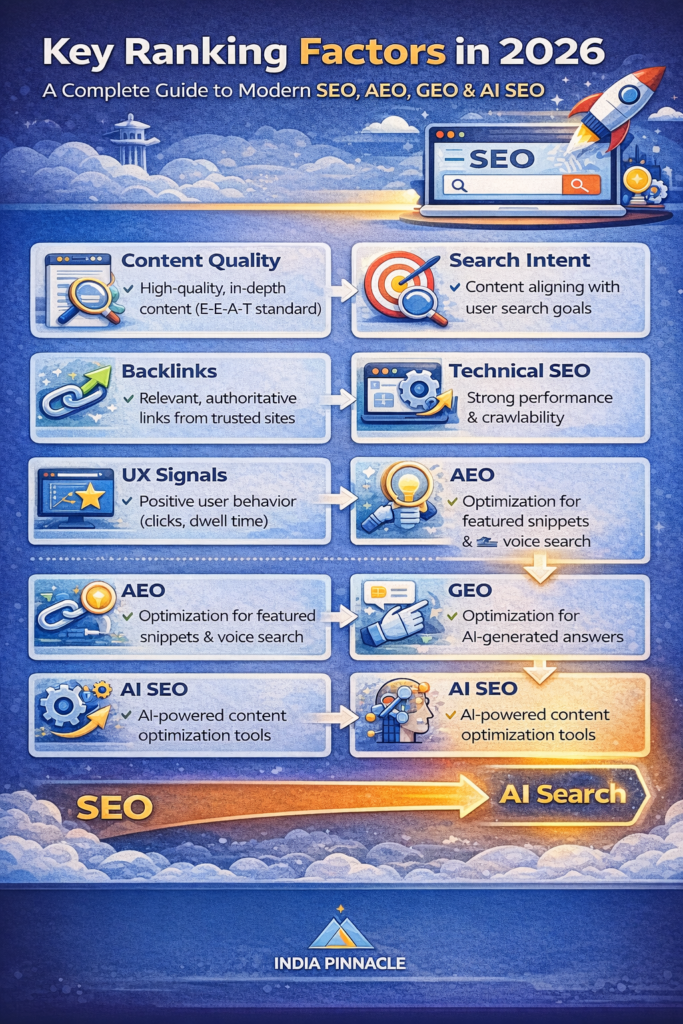
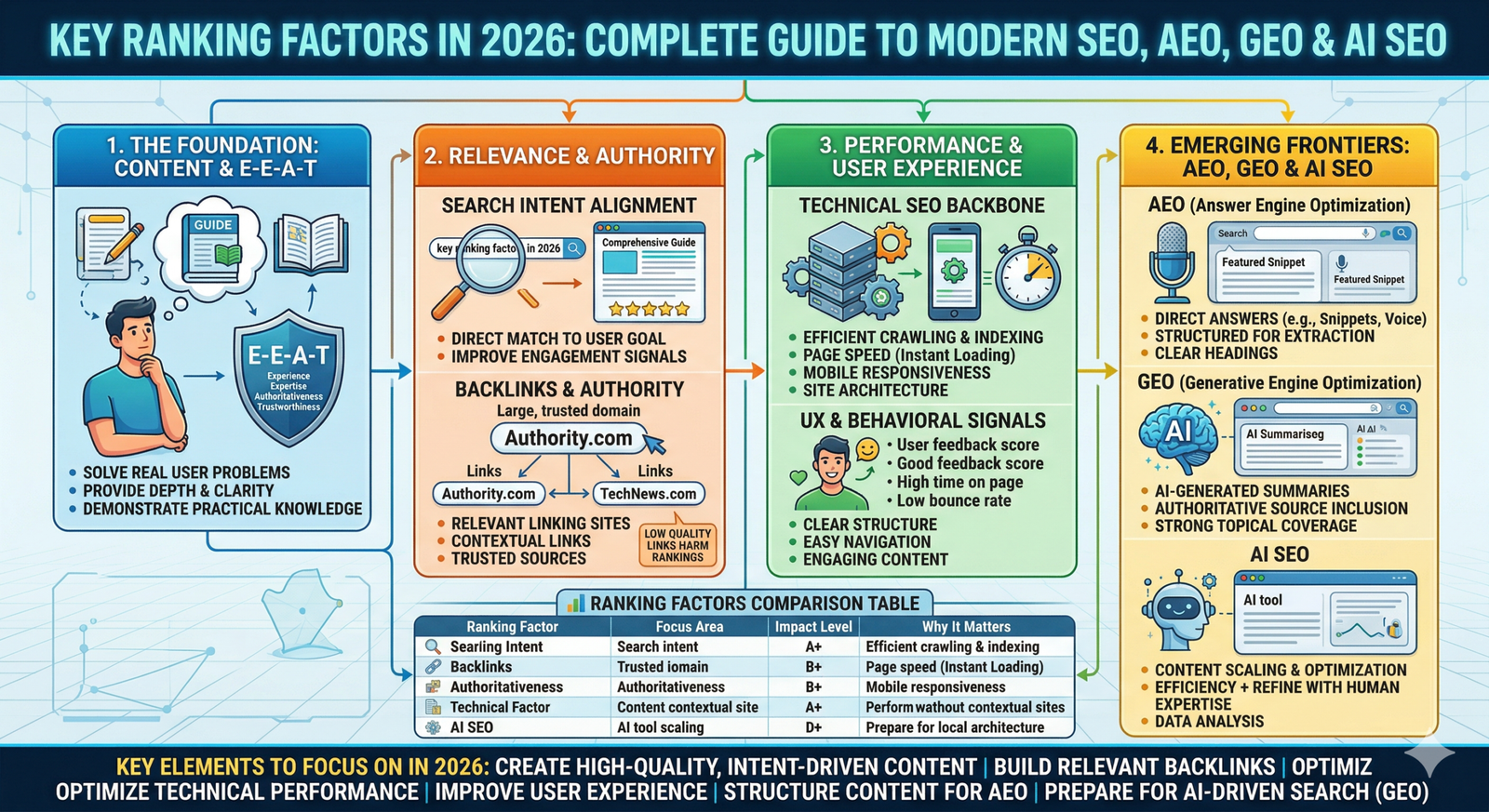
    Key Ranking Factors in 2026: Complete Guide to Modern SEO, AEO, GEO & AI SEO

    Introduction

    Understanding the key ranking factors in 2026 is essential if you want to stay ahead. This guide will break down the most important factors that influence rankings today and explain how they connect to the future of search.

    Search engine optimization has evolved far beyond traditional practices like keyword stuffing and basic backlinks. In 2026, ranking on Google is no longer just about optimizing pages — it is about understanding how search engines interpret content, user behavior, and even AI-generated answers.

    If you look at how search results are changing, you will notice a clear shift. Search engines are no longer just listing websites; they are directly answering questions, generating summaries, and prioritizing highly relevant content. This transformation has introduced new concepts such as Answer Engine Optimization (AEO), Generative Engine Optimization (GEO), and AI-driven SEO strategies.

    Quick Overview of Key Ranking Factors in 2026

    Before diving deeper, here are the most important ranking factors:

    • Content quality and E-E-A-T
    • Search intent alignment
    • Backlinks and authority
    • Technical SEO performance
    • User experience and engagement
    • AEO (featured snippets & voice search)
    • GEO (AI-generated search results)
    • AI SEO (content creation & optimization)

    These factors work together as a system rather than independently.

    Ranking Factors Comparison Table

    Ranking FactorFocus AreaImpact LevelWhy It Matters
    Content QualityValue & depthVery HighCore ranking driver
    Search IntentRelevanceVery HighMatches user needs
    BacklinksAuthorityHighBuilds trust
    Technical SEOPerformanceHighEnables crawling/indexing
    UX SignalsUser behaviorHighReflects satisfaction
    AEODirect answersGrowingFeatured snippets & voice
    GEOAI search visibilityEmergingAI-generated results
    AI SEOContent scalingGrowingEfficiency + optimization
    Key Ranking Factors in seo

    Content Quality and E-E-A-T as the Foundation

    Content remains the strongest ranking factor, but its definition has evolved. In 2026, content quality is measured through E-E-A-T — Experience, Expertise, Authoritativeness, and Trustworthiness.

    Search engines evaluate whether your content demonstrates real understanding and practical knowledge. Generic content written only for rankings no longer performs well.

    To meet this standard, your content must:

    • Solve real user problems
    • Provide depth and clarity
    • Reflect expertise in the subject

    This is why your current content strategy — building clusters and deep guides — is aligned with modern ranking systems.

    Search Intent as the Core of Relevance

    Understanding search intent is critical when analyzing key ranking factors in 2026.

    Search engines prioritize content that directly matches what the user is trying to achieve. This means your content must align with the purpose behind the query, not just the keyword itself.

    For example, a search for “key ranking factors in 2026” expects a comprehensive and updated guide. If your content fails to meet that expectation, it will not rank effectively.

    Intent-driven content performs better because it satisfies users, which improves engagement signals.

    Backlinks and Authority Still Matter

    Despite the rise of AI and new ranking systems, backlinks remain a strong authority signal.

    However, the approach has changed. Search engines now evaluate:

    • Relevance of the linking site
    • Context of the link
    • Overall authority of the domain

    Spammy or low-quality links can harm your rankings. On the other hand, high-quality backlinks from trusted sources significantly boost your credibility.

    Backlinks work best when combined with strong content. Without valuable content, even good links may not produce long-term results.

    Technical SEO as the Backbone

    Technical SEO ensures that your website can be properly crawled, indexed, and understood.

    Even if your content is excellent, technical issues can prevent it from ranking. Factors such as page speed, mobile responsiveness, and clean site architecture directly influence performance.

    This connects to how search engines work. If your pages cannot be accessed or processed efficiently, they will struggle to appear in search results.

    Technical SEO does not directly attract users, but it enables everything else to function effectively.

    User Experience and Behavioral Signals

    User experience has become one of the most influential ranking factors.

    Search engines analyze how users interact with your content. Metrics such as time on page, click-through rate, and engagement levels help determine whether your content is valuable.

    If users quickly leave your page, it signals dissatisfaction. If they stay, read, and explore further, it signals quality.

    Improving user experience involves:

    • Clear structure
    • Easy navigation
    • Engaging content

    These factors indirectly influence rankings by improving behavioral signals.

    AEO (Answer Engine Optimization) and Featured Visibility

    AEO focuses on optimizing content to appear as direct answers in search results.

    This includes:

    • Featured snippets
    • Voice search responses
    • “People Also Ask” sections

    Search engines are increasingly providing answers directly, reducing the need for users to click on links. This means your content must be structured in a way that can be easily extracted and displayed.

    Using clear headings, concise explanations, and structured formats increases your chances of appearing in these positions.

    GEO (Generative Engine Optimization) and AI Search

    GEO is one of the most important emerging concepts in modern SEO.

    With AI-driven search experiences, such as generative search results, search engines create summaries based on multiple sources. Your content must be strong enough to be included in these summaries.

    This requires:

    • High-quality, authoritative content
    • Clear structure
    • Strong topical coverage

    GEO focuses on making your content “AI-readable” and trustworthy.

    AI SEO and Content Evolution

    AI is transforming how content is created and optimized.

    AI tools can help scale content production, analyze data, and improve efficiency. However, relying entirely on AI-generated content without human refinement can lead to low-quality output.

    The most effective strategy is combining AI with human expertise. This ensures content remains accurate, valuable, and aligned with user intent.

    AI SEO is not about replacing humans — it is about enhancing productivity while maintaining quality.

    Key Elements to Focus on in 2026

    To simplify, here are the most actionable elements you should focus on:

    • Create high-quality, intent-driven content
    • Build relevant backlinks
    • Optimize technical performance
    • Improve user experience
    • Structure content for AEO
    • Prepare content for AI-driven search (GEO)

    Focusing on these areas will help you stay competitive.

    Conclusion

    The key ranking factors in 2026 reflect a major shift in how search engines operate. SEO is no longer just about optimizing pages — it is about creating a complete ecosystem that combines content, authority, performance, and user experience.

    With the rise of AEO, GEO, and AI SEO, the future of search is becoming more intelligent and user-focused. Websites that adapt to these changes will have a significant advantage.

    Instead of chasing outdated tactics, focus on building a strong foundation and evolving with the search landscape. This is the approach that leads to sustainable rankings.

    FAQs

    What are the most important ranking factors in 2026?

    Content quality, search intent, backlinks, technical SEO, and user experience are the most important factors.

    What is AEO in SEO?

    AEO focuses on optimizing content for direct answers like featured snippets and voice search.

    What is GEO in SEO?

    GEO is about optimizing content for AI-generated search results and summaries.

    Want your website optimized for modern SEO and AI-driven search?
  • 4 Different Types of SEO Explained

    4 Different Types of SEO Explained

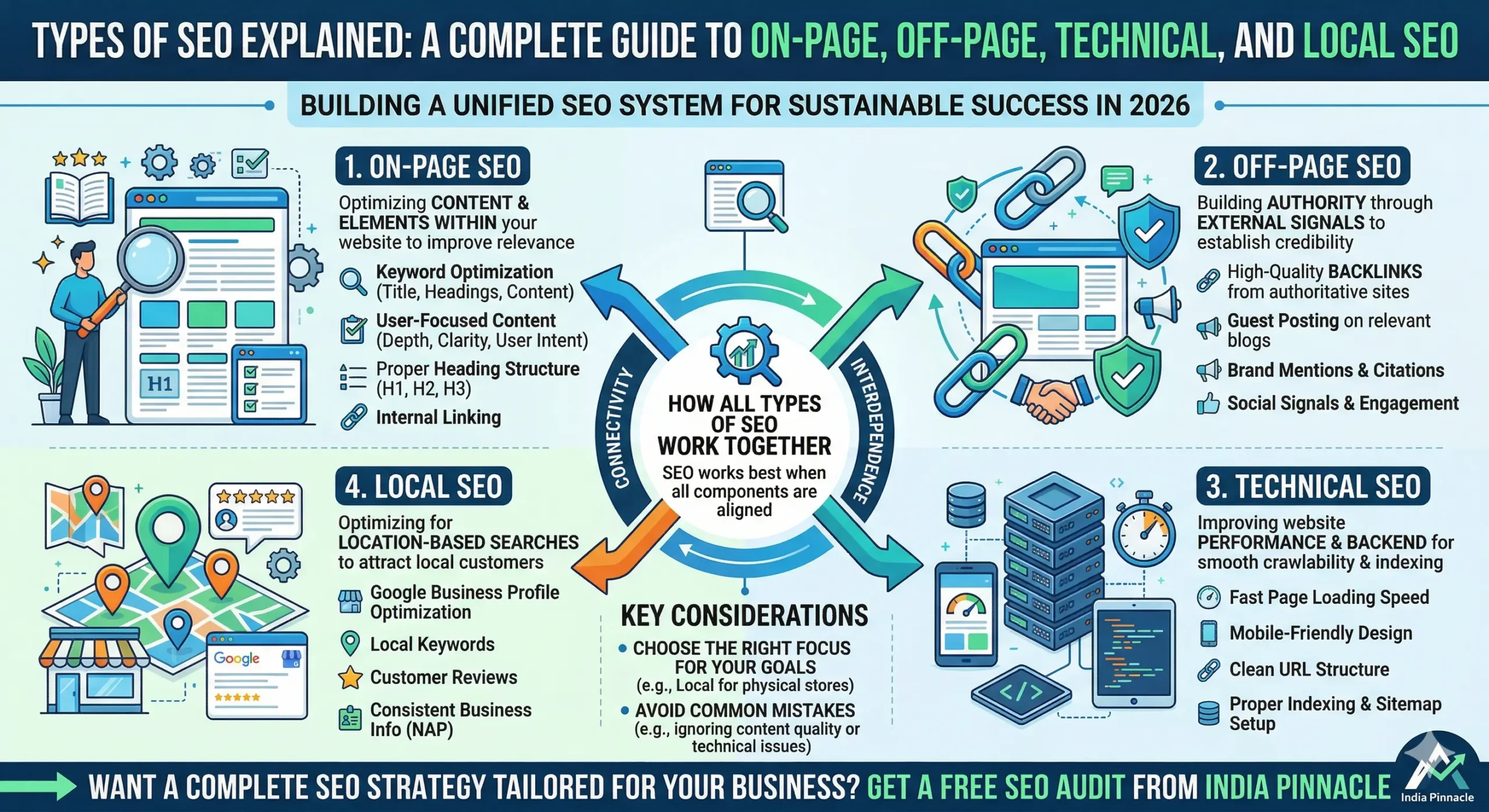
    Types of SEO Explained: A Complete Guide to On-Page, Off-Page, Technical and Local SEO

    Introduction

    If you’re trying to understand SEO, one of the most important things to grasp is that it is not a single activity. SEO is a combination of multiple strategies working together to improve your website’s visibility on search engines.

    Many beginners focus only on one aspect, such as keywords or backlinks, without realizing that SEO is a system. To build a strong online presence, you need to understand the different types of SEO and how they interact with each other.

    In 2026, search engines evaluate websites holistically. This means your rankings depend not just on content, but also on authority, technical performance, and relevance to user location.

    In this guide, we will break down the main types of SEO and explain how each one contributes to your overall strategy.

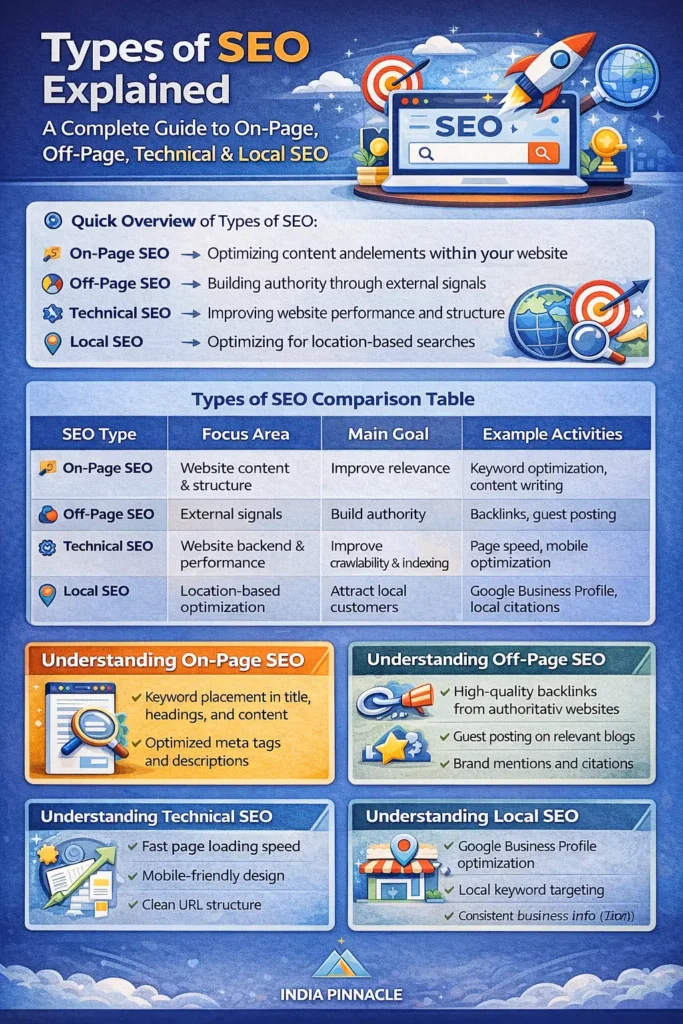
    Quick Overview of Types of SEO

    To understand the structure, here are the main types of SEO:

    • On-Page SEO → Optimizing content and elements within your website
    • Off-Page SEO → Building authority through external signals
    • Technical SEO → Improving website performance and structure
    • Local SEO → Optimizing for location-based searches

    Each type plays a specific role, and ignoring any one of them can limit your growth.

    SEO TypeFocus AreaMain GoalExample Activities
    On-Page SEOWebsite content & structureImprove relevanceKeyword optimization, content writing
    Off-Page SEOExternal signalsBuild authorityBacklinks, guest posting
    Technical SEOWebsite backend & performanceImprove crawlability & indexingPage speed, mobile optimization
    Local SEOLocation-based optimizationAttract local customersGoogle Business Profile, local citations
    types of seo

    Understanding On-Page SEO in Depth

    On-page SEO focuses on everything that exists within your website. It is the foundation of your SEO strategy because it directly controls how your content is presented to both users and search engines.

    When you optimize a page, you are essentially making it easier for search engines to understand what your content is about. This includes using the right keywords, structuring your content properly, and ensuring clarity.

    However, modern on-page SEO goes beyond technical placement. It involves creating content that aligns with user intent. If a user lands on your page and finds exactly what they are looking for, it sends strong signals to search engines.

    This is why your on-page SEO checklist plays a critical role. It ensures that every page you create is optimised not just for ranking, but for usability and engagement.

    Key Elements of On-Page SEO

    • Keyword placement in title, headings, and content
    • Optimized meta tags and descriptions
    • Proper heading structure (H1, H2, H3)
    • Internal linking between pages
    • High-quality, user-focused content

    Understanding Off-Page SEO and Authority Building

    While on-page SEO builds your foundation, off-page SEO determines your authority.

    Off-page SEO refers to actions taken outside your website to improve its credibility. The most important component of off-page SEO is backlinks — links from other websites pointing to your content.

    Search engines treat backlinks as votes of confidence. When reputable websites link to you, it signals that your content is valuable and trustworthy.

    However, not all backlinks are equal. Quality matters far more than quantity. A few strong links from authoritative websites can have a much greater impact than hundreds of low-quality links.

    Off-page SEO also includes brand mentions, social signals, and online reputation. Together, these factors help establish your website as an authority in your niche.

    Key Elements of Off-Page SEO

    • High-quality backlinks from authoritative websites
    • Guest posting on relevant blogs
    • Brand mentions and citations
    • Social signals and engagement

    Understanding Technical SEO and Website Performance

    Technical SEO focuses on the backend aspects of your website that affect how search engines crawl and index your content.

    Even if your content is excellent, technical issues can prevent it from ranking. For example, if your pages load slowly, are not mobile-friendly, or have indexing issues, search engines may struggle to evaluate them properly.

    Technical SEO ensures that your website is accessible, fast, and easy to navigate. It includes elements such as:

    • Website speed optimization
    • Mobile responsiveness
    • Proper URL structure
    • Fixing crawl errors

    This connects directly to how search engines work, especially the crawling and indexing stages.

    Think of technical SEO as the infrastructure that supports your content. Without it, even the best strategies can fail.

    Key Elements of Technical SEO

    • Fast page loading speed
    • Mobile-friendly design
    • Clean URL structure
    • Proper indexing and sitemap setup

    Understanding Local SEO and Geographic Relevance

    Local SEO is essential for businesses that target specific locations.

    When users search for services near them, search engines prioritize results that are geographically relevant. This is where local SEO comes into play.

    It involves optimizing your website and online presence so that you appear in local search results and Google Maps.

    Key elements of local SEO include:

    • Google Business Profile optimization
    • Local keywords
    • Customer reviews
    • Consistent business information (NAP)

    For businesses in India, local SEO can drive highly targeted traffic with strong intent. Users searching for services in their area are often ready to take action.

    How All Types of SEO Work Together

    One of the biggest mistakes people make is treating these types of SEO as separate strategies.

    In reality, they are interconnected.

    Your on-page SEO ensures your content is clear and relevant. Your technical SEO ensures it can be accessed and understood. Your off-page SEO builds authority, and your local SEO ensures relevance to specific audiences.

    If one of these areas is weak, it affects your overall performance.

    For example, strong content without backlinks may struggle to rank. Similarly, high authority without proper on-page optimization may fail to convert visitors.

    SEO works best when all components are aligned.

    Choosing the Right SEO Focus for Your Website

    The importance of each SEO type depends on your goals.

    If you are just starting, focusing on on-page SEO and content creation is essential. This builds your foundation.

    As your website grows, off-page SEO becomes more important to increase authority.

    Technical SEO should always be maintained to ensure smooth performance, while local SEO is critical if your business depends on location-based customers.

    Understanding where to focus allows you to allocate your efforts effectively.

    Common Mistakes When Understanding SEO Types

    Many beginners misunderstand how these SEO types function.

    Some focus only on backlinks and ignore content quality. Others create content without optimizing it properly. Technical issues are often overlooked, which can prevent pages from being indexed.

    Another common mistake is ignoring local SEO, especially for businesses that rely on local customers.

    Avoiding these mistakes ensures a more balanced and effective strategy.

    Conclusion

    Understanding the different types of SEO is essential for building a successful online presence.

    SEO is not about choosing one strategy over another. It is about combining on-page, off-page, technical, and local SEO into a unified approach.

    When these elements work together, they create a strong foundation that supports long-term growth.

    Instead of focusing on isolated tactics, focus on building a complete system. This is what leads to consistent rankings and sustainable success.

    FAQs

    What are the main types of SEO?

    On-page SEO, off-page SEO, technical SEO, and local SEO are the main types.

    Which type of SEO is most important?

    On-page SEO is the foundation, but all types are important for overall performance.

    Can I rank using only one type of SEO?

    It is possible in low competition, but long-term success requires all types working together.

    Want a complete SEO strategy tailored for your business?

  • How Search Engines Work: Crawling, Indexing and Ranking

    How Search Engines Work: Crawling, Indexing and Ranking

    How Search Engines Work: Crawling, Indexing, and Ranking Explained

    Introduction

    Whenever you search for something on Google, you get thousands of results in a fraction of a second. But have you ever wondered how search engines decide which pages to show and in what order?

    Understanding how search engines work is one of the most important foundations of SEO. Without this knowledge, optimizing your website becomes guesswork. Once you understand the process behind crawling, indexing, and ranking, you can align your strategy with how search engines actually evaluate content.

    In 2026, search engines have become incredibly advanced. They don’t just scan pages — they interpret meaning, evaluate user behavior, and prioritize content that truly satisfies search intent.

    This guide will help you understand how search engines work in a clear and practical way so you can apply it directly to your website.

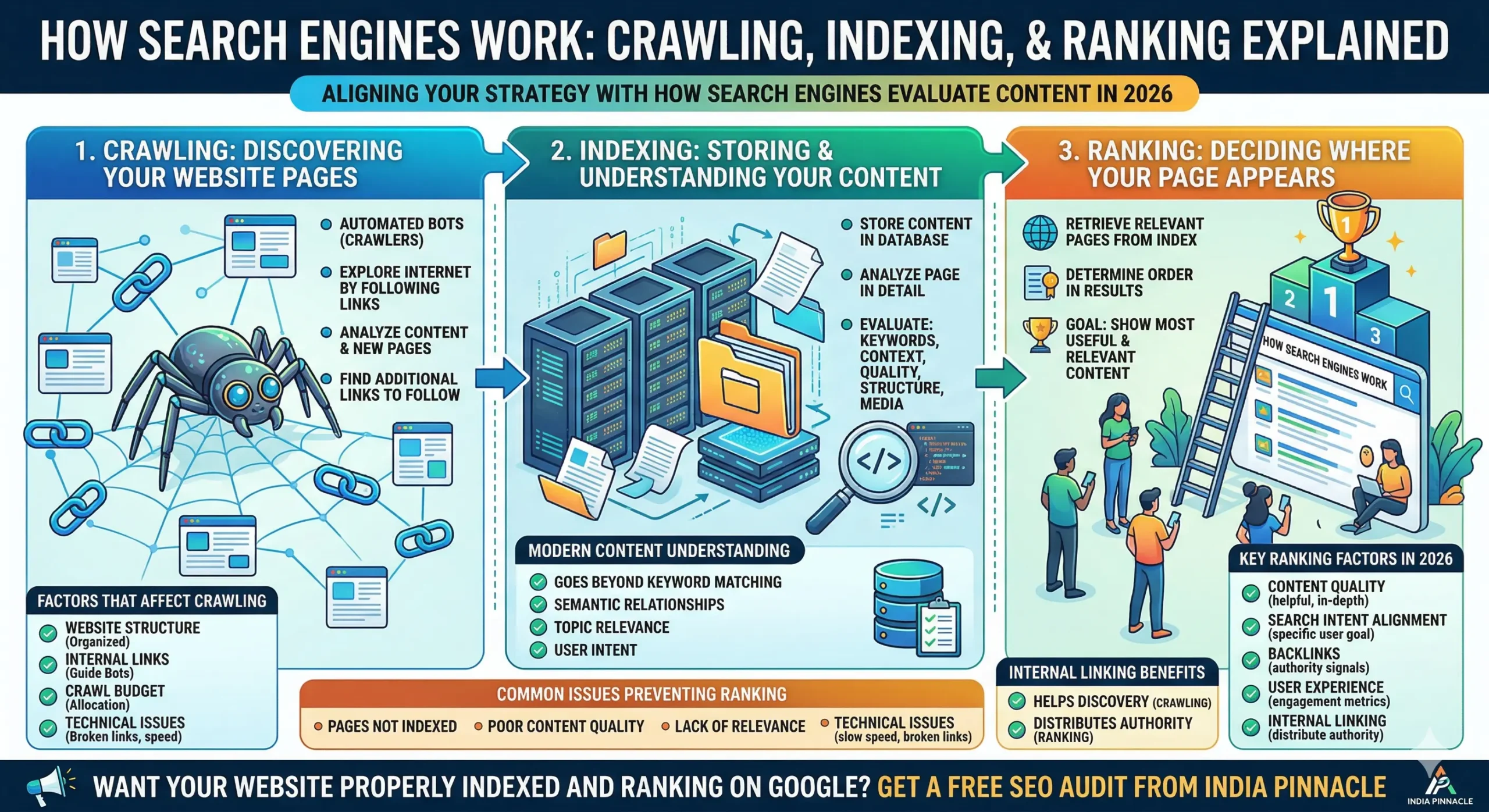
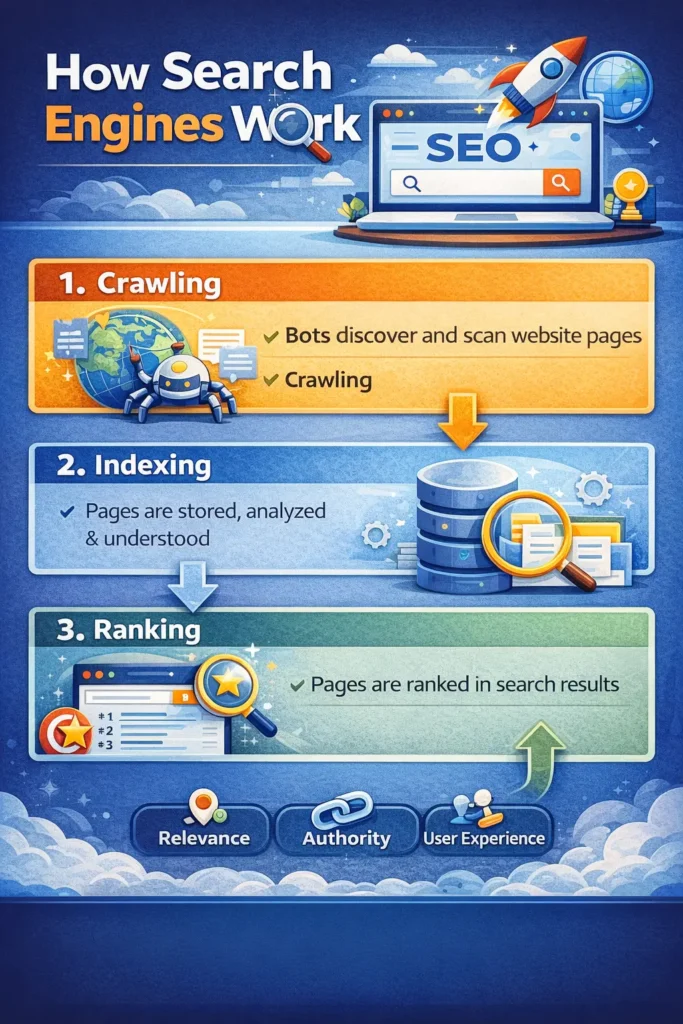
    Quick Overview: How Search Engines Work

    If you want a simplified view, here’s how search engines work:

    • Crawling → Discovering your website pages
    • Indexing → Storing and understanding your content
    • Ranking → Deciding where your page appears in search results

    These three stages form the backbone of every search engine.

    how search engine works

    What is Crawling and How It Works

    Crawling is the first step in how search engines work. It is the process through which search engines discover new and updated web pages.

    Search engines use automated bots, often referred to as crawlers or spiders, to explore the internet. These bots move from one page to another by following links. Every time they land on a page, they analyze its content and look for additional links to follow.

    If your website is well-structured and properly linked, these bots can easily navigate through your pages. However, if your site lacks internal linking or has broken paths, some pages may remain undiscovered.

    Crawling is not just about finding pages — it is about accessibility. If search engines cannot access your content, it simply does not exist for them.

    Factors That Affect Crawling

    Several factors influence how efficiently search engines crawl your website.

    One of the most important factors is your website structure. A clean and organized structure makes it easier for crawlers to navigate your site. Internal links play a crucial role here, as they guide bots from one page to another.

    Another factor is crawl budget. Search engines allocate a certain amount of resources to crawl your site. If your website has too many low-value pages or duplicate content, it can waste this budget and prevent important pages from being crawled.

    Technical issues such as broken links, slow loading times, or blocked pages can also negatively impact crawling.

    What is Indexing and Why It Matters

    Once a page is discovered through crawling, the next step is indexing.

    Indexing is the process of storing and organizing your content in a search engine’s database. During this stage, search engines analyze your page in detail to understand what it is about.

    They evaluate:

    • Keywords and context
    • Content quality
    • Structure
    • Media elements

    If your page meets the required standards, it gets added to the index. Only indexed pages are eligible to appear in search results.

    If your page is not indexed, it does not matter how optimized it is — it simply won’t rank.

    How Search Engines Understand Content

    Modern search engines go beyond simple keyword matching. They use advanced algorithms to understand the meaning behind your content.

    This includes analyzing:

    • Topic relevance
    • Semantic relationships between words
    • User intent

    For example, if your page talks about “on-page SEO checklist,” search engines also expect related concepts like content optimization, internal linking, and keyword placement.

    This is why creating comprehensive content is essential.

    What is Ranking and How It Works

    Ranking is the final stage in how search engines work. This is where search engines decide the order in which pages appear in search results.

    When a user enters a query, search engines scan their index and retrieve the most relevant pages. These pages are then ranked based on multiple factors.

    The goal is simple: show the most useful and relevant content at the top.

    Key Ranking Factors in 2026

    Ranking is influenced by a combination of factors working together.

    Content quality remains the most important factor. Pages that provide clear, helpful, and in-depth information are more likely to rank higher.

    Search intent alignment is equally critical. If your content does not match what the user is looking for, it will struggle to perform.

    Backlinks act as authority signals, indicating that your content is trusted by other websites.

    User experience also plays a major role. Metrics such as time on page, bounce rate, and engagement help search engines evaluate how users interact with your content.

    The Role of Search Intent in Ranking

    Search intent is one of the most important concepts in modern SEO.

    When someone searches for a query, they have a specific goal. It could be to learn something, compare options, or make a purchase.

    Search engines analyze this intent and prioritize content that best satisfies it.

    For example, a search for “how search engines work” requires informational content. If your page tries to sell a service instead, it will not rank well.

    Understanding intent allows you to create content that aligns with what users actually want.

    How Internal Linking Supports Crawling and Ranking

    Internal linking connects your content and plays a vital role in how search engines work.

    From a crawling perspective, internal links help search engines discover new pages. From a ranking perspective, they distribute authority across your site.

    When you link related pages together, you create a structured network of content. This strengthens your topical authority and improves overall visibility.

    Common Issues That Prevent Pages from Ranking

    Even if you understand how search engines work, certain issues can prevent your pages from performing well.

    Pages that are not properly indexed will never appear in search results. Poor content quality or lack of relevance can also limit rankings.

    Technical issues such as slow loading speeds or broken links can negatively impact both crawling and user experience.

    Fixing these issues is essential for improving your SEO performance.

    Conclusion

    Understanding how search engines work is the foundation of every successful SEO strategy. From crawling to indexing to ranking, each stage plays a crucial role in determining your visibility. When you align your website with these processes, you make it easier for search engines to understand and rank your content. Instead of trying to outsmart search engines, focus on working with them. Create valuable content, maintain a strong structure, and ensure a smooth user experienceThis approach will always lead to better results.

    FAQs

    How do search engines work in simple terms?

    They discover pages (crawl), store them (index), and rank them based on relevance.

    Why is indexing important?

    Only indexed pages can appear in search results.

    How long does it take for Google to index a page?

    It can take a few hours to several days depending on your website.

    Want your website properly indexed and ranking on Google?

  • On-Page SEO Checklist (Complete Guide)

    On-Page SEO Checklist (Complete Guide)

    Introduction

    If your website isn’t ranking on Google, the problem is often not your strategy — it’s your execution. Most websites fail because they miss the fundamentals, and that’s exactly where an on-page SEO checklist becomes critical.

    In 2026, SEO is no longer about tricks or shortcuts. Search engines evaluate how well your page satisfies user intent, how clearly it is structured, and how valuable the content is. This means your pages must be optimized not just for algorithms, but for real users.

    This guide is designed to give you both — a quick actionable checklist and a deep understanding of how on-page SEO actually works.

    Quick On-Page SEO Checklist (For Fast Implementation)

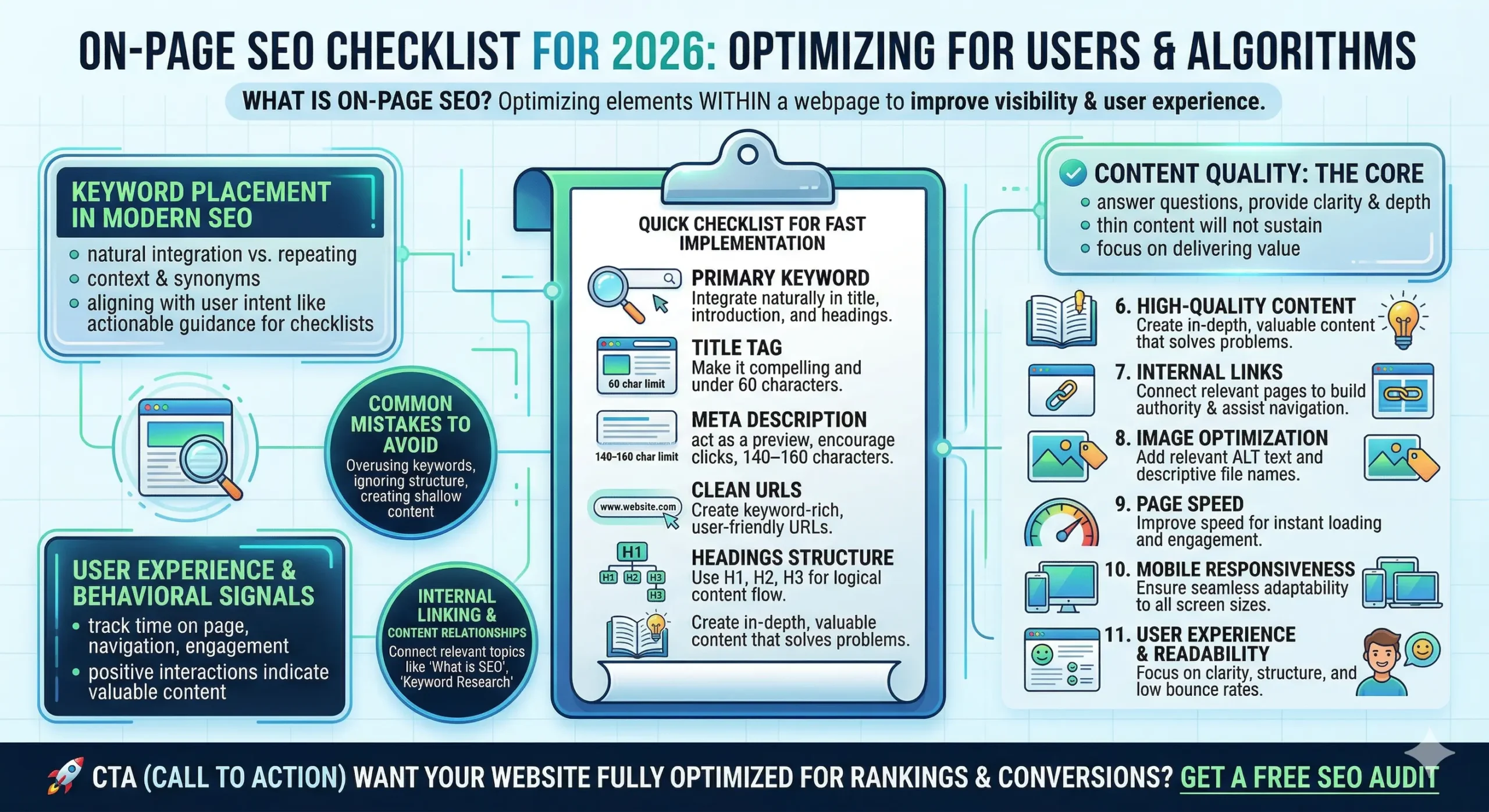
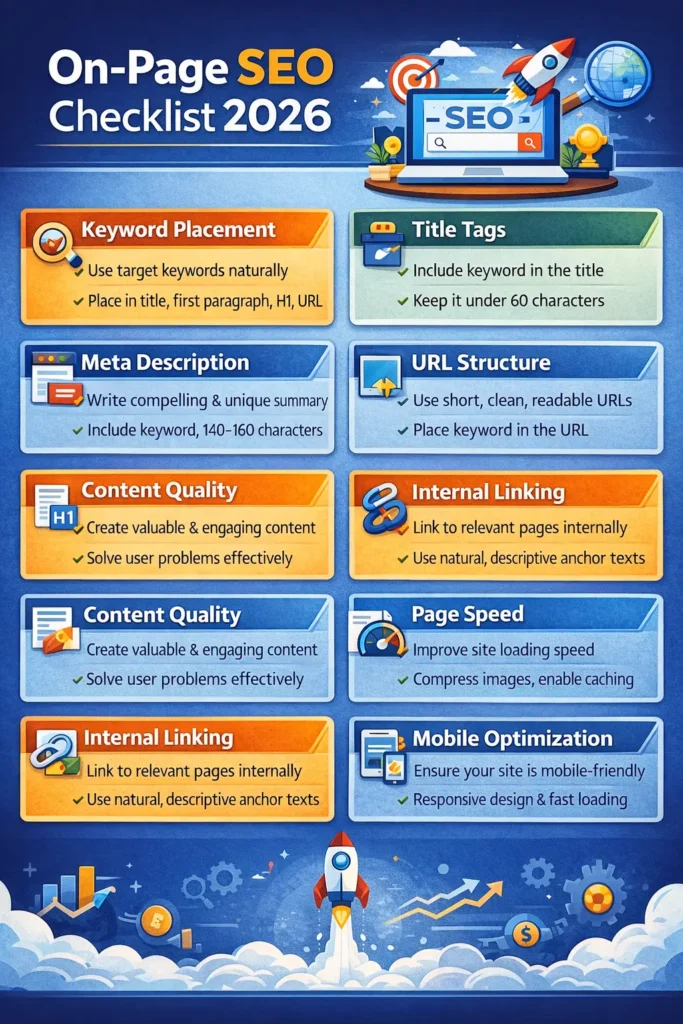
    If you want a quick overview, here’s the complete on-page SEO checklist you can follow:

    • Use your primary keyword naturally (title, intro, headings)
    • Write a compelling title tag (under 60 characters)
    • Optimize meta description (140–160 characters)
    • Use clean, keyword-rich URLs
    • Structure content with proper headings (H1, H2, H3)
    • Create high-quality, in-depth content
    • Add internal links to relevant pages
    • Optimize images with ALT text
    • Improve page speed
    • Ensure mobile responsiveness
    • Focus on user experience and readability

    This checklist gives you the framework, but understanding why each step matters is what will help you rank consistently.

    What is On-Page SEO and Why It Matters

    On-page SEO refers to optimizing elements within your webpage so that search engines can understand your content and rank it appropriately.

    Unlike off-page SEO, which depends on external signals like backlinks, on-page SEO is fully within your control. It determines how clearly your page communicates its purpose to both users and search engines.

    When you follow a proper on-page SEO checklist, you’re not just optimizing for rankings — you’re improving clarity, usability, and engagement. These factors directly influence how search engines evaluate your content.

    Understanding Keyword Placement in Modern SEO

    One of the most important elements of any on-page SEO checklist is keyword placement. However, the way keywords are used today is very different from earlier SEO practices.

    Instead of repeating the keyword excessively, the focus is now on natural integration. Search engines are capable of understanding context, synonyms, and related phrases.

    Placing your keyword strategically in the title, introduction, and headings helps establish relevance. But what truly matters is how well your content aligns with the user’s intent behind that keyword.

    For example, someone searching for an “on-page SEO checklist” is looking for actionable guidance. If your content delivers clarity and depth, it will naturally perform better.

    onpage seo checklist

    The Importance of Titles and Click Behavior

    Your title is more than just a heading — it is your first impression on search engines.

    A well-crafted title should clearly communicate what the page is about while also encouraging users to click. Including the keyword in the title helps with relevance, but adding elements like the current year or power words can improve click-through rates.

    Higher click-through rates send positive signals to search engines, reinforcing your page’s relevance.

    Meta Descriptions and Their Role in SEO

    Although meta descriptions are not a direct ranking factor, they play a crucial role in user behavior.

    A well-written meta description acts as a preview of your content. It should clearly explain what the user can expect while subtly encouraging them to click.

    When more users choose your page over others, it improves your overall performance in search results.

    Structuring Content for Better Understanding

    Content structure is a critical but often overlooked part of on-page SEO.

    Using headings properly helps both users and search engines navigate your content. It creates a logical hierarchy, making it easier to understand the flow of information.

    Well-structured content also improves readability, which increases engagement and reduces bounce rates.

    Content Quality: The Core of Every SEO Strategy

    At the heart of every successful on-page SEO checklist is content quality.

    Search engines prioritize content that genuinely helps users. This means your content should not only answer questions but also provide clarity, depth, and actionable insights.

    Thin or generic content may rank temporarily, but it will not sustain long-term performance.

    Internal Linking and Content Relationships

    Internal linking is a powerful strategy that connects your content and builds authority.

    When you link related pages together, you help search engines understand your website structure. It also allows users to explore more content, increasing their time on your site.

    For example, this page should link to your “What is SEO” guide and future blogs like keyword research or technical SEO.

    Image Optimization and Performance

    Images enhance user experience, but they must be optimized properly.

    Search engines rely on ALT text and file names to understand images. Including relevant descriptions improves accessibility and SEO.

    At the same time, optimizing image size ensures faster loading speeds, which directly impacts user experience.

    Page Speed and Its Impact on Rankings

    Speed is no longer optional. Users expect pages to load instantly, and search engines consider this when ranking content.

    A slow website leads to higher bounce rates, which signals poor user experience. Improving speed through optimization techniques ensures better performance and higher engagement.

    Mobile Optimization as a Ranking Factor

    With the majority of users accessing websites through mobile devices, mobile optimization has become a priority.

    Your website must adapt seamlessly to different screen sizes while maintaining readability and usability.

    A mobile-friendly design improves both user satisfaction and search visibility.

    User Experience and Behavioral Signals

    Modern SEO is heavily influenced by how users interact with your content.

    Search engines track behavior such as time spent on the page, navigation patterns, and engagement levels. Positive interactions indicate that your content is valuable.

    Improving user experience through clarity, structure, and relevance strengthens these signals.

    Common Mistakes That Limit Rankings

    Even with a solid on-page SEO checklist, certain mistakes can hold your website back.

    Overusing keywords, ignoring structure, and creating shallow content are common issues. Similarly, failing to update content or neglecting internal linking can weaken your SEO performance.

    Avoiding these mistakes is essential for long-term success.

    Conclusion

    An effective on-page SEO checklist is not just about following steps — it is about building a system where every element of your page works together.

    From keyword placement to content quality to user experience, each factor contributes to your overall performance. When combined, they create a strong foundation for sustainable rankings.

    Instead of focusing on shortcuts, focus on delivering value and clarity. This approach will always win in the long run.

    FAQs

    What is an on-page SEO checklist?

    It is a structured list of optimizations used to improve a webpage’s ranking on search engines.

    How often should I update on-page SEO?

    Regular updates every few months help maintain rankings and relevance.

    Is on-page SEO enough to rank?

    For low-competition keywords, yes. For competitive niches, it must be combined with off-page SEO.

    Want your website fully optimised for rankings and conversions?

  • What is SEO in 2026? A Complete Beginner’s Guide to SEO

    What is SEO in 2026? A Complete Beginner’s Guide to SEO

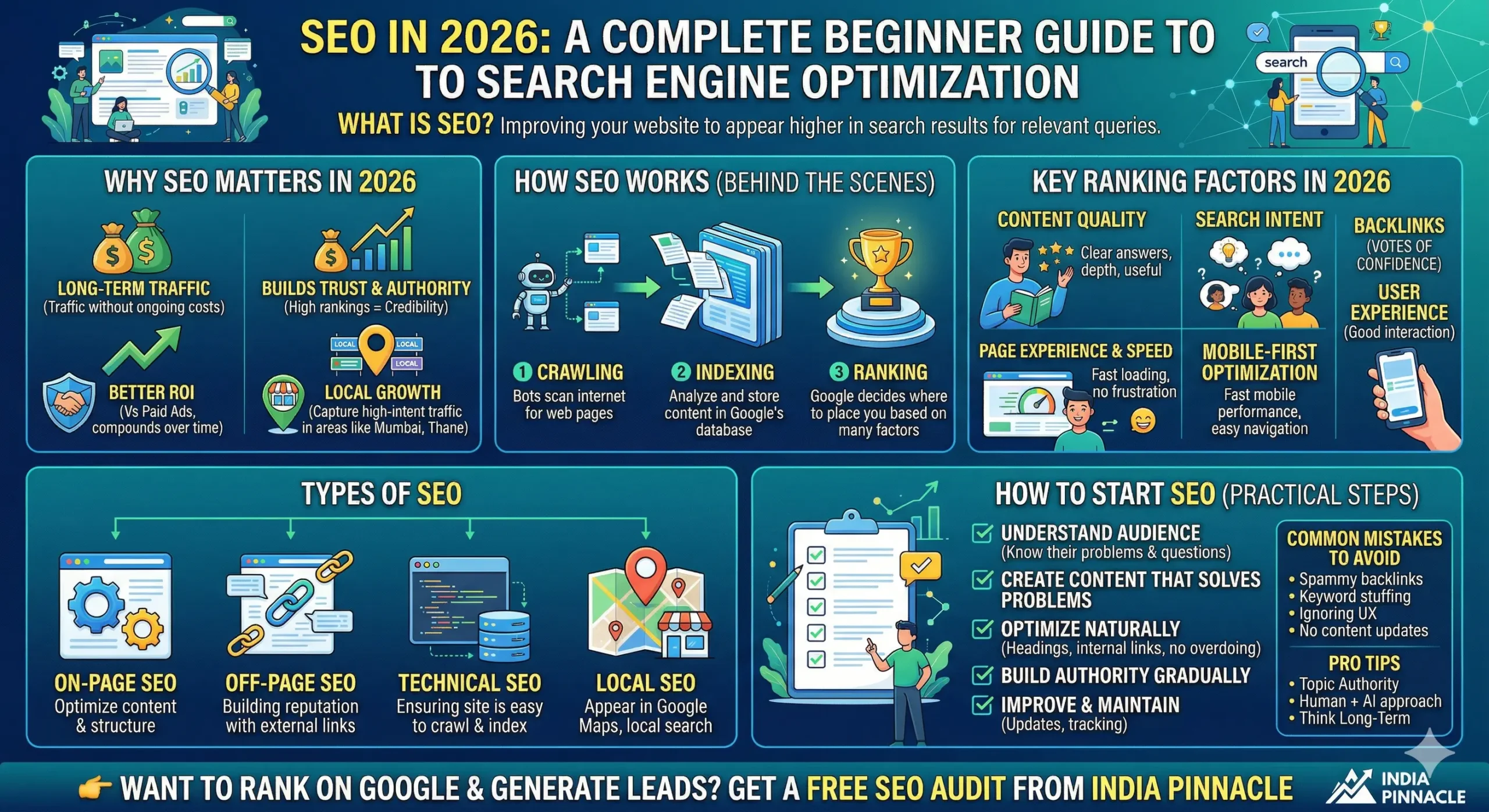
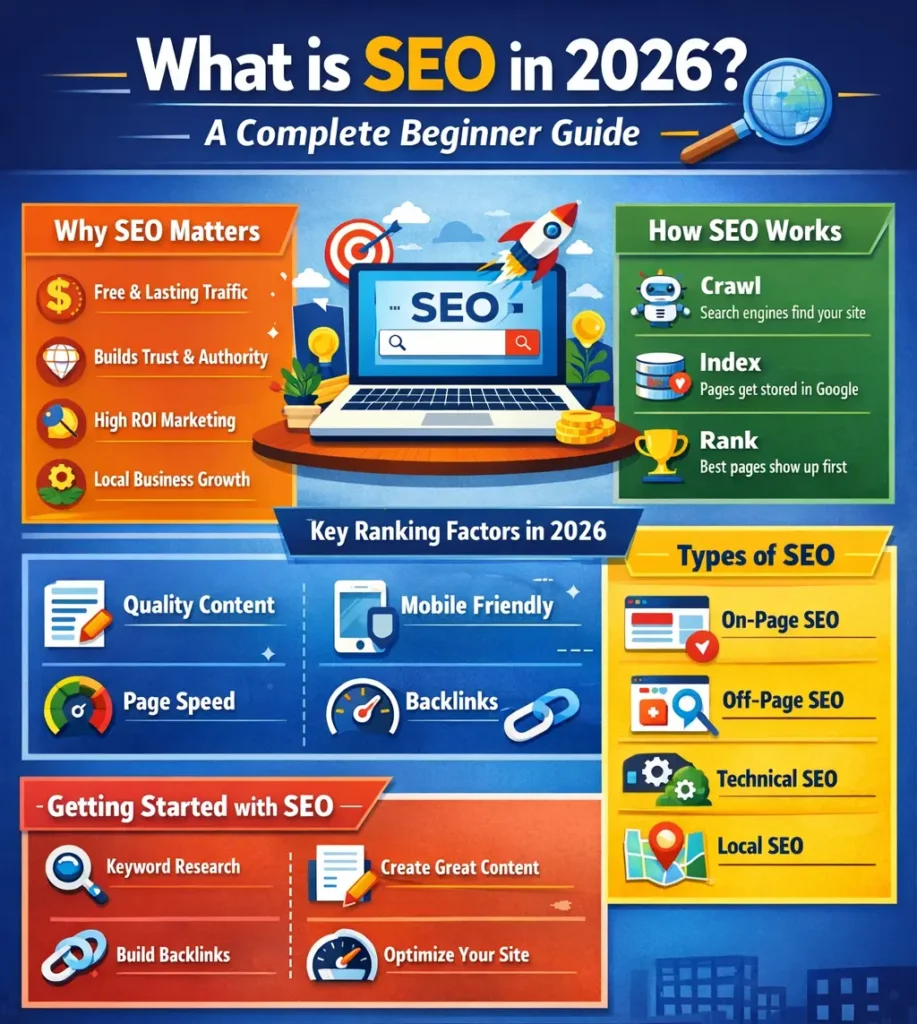
    Search Engine Optimisation (SEO) is the process of improving your website so that it appears higher in search results when users search for relevant queries.
    Introduction

    Launching a website today is easier than ever. But getting people to actually visit that website? That’s where most businesses struggle.

    You might have a well-designed site, great services, and competitive pricing — but if your website isn’t appearing on Google when people search, you’re essentially invisible. This is exactly the problem that Search Engine Optimization (SEO) solves.

    In 2026, SEO is no longer just about inserting keywords or building random backlinks. It has evolved into a sophisticated system that focuses on user intent, content quality, authority, and experience. Google’s algorithms are smarter, users are more demanding, and competition is higher than ever.

    This guide will help you understand SEO from the ground up — not just what it is, but how it actually works and how you can start using it to grow your business.

    What is SEO?

    Search Engine Optimization (SEO) is the process of improving your website so that it appears higher in search engine results when users search for relevant queries.

    But to truly understand SEO, you need to go beyond the definition.

    SEO is about connecting your content with the exact moment someone is searching for it.

    For example, when a user types “best SEO agency in India,” they are not just browsing — they are actively looking for a service. If your website appears at that moment, you are capturing highly valuable traffic with strong intent.

    This is what makes SEO powerful:

    • It targets users already interested
    • It brings organic (free) traffic
    • It compounds over time

    In essence, SEO is the bridge between your website and your audience.

    Why SEO is Important in 2026

    Many businesses still treat SEO as optional or secondary. In reality, it has become one of the most critical components of digital growth.

    Long-Term Traffic Without Ongoing Costs

    Unlike paid advertising, where traffic stops the moment you stop spending, SEO works differently. Once your content ranks well, it can continue attracting visitors consistently over time.

    This creates a compounding effect. A single well-optimized article can bring in traffic for months or even years, reducing your dependence on paid campaigns.

    Trust is Built Through Visibility

    Users inherently trust search engines. When your website appears at the top of search results, it signals credibility.

    People often associate higher rankings with:

    • Expertise
    • Authority
    • Reliability

    This psychological factor plays a huge role in decision-making, especially for service-based businesses.

    Better ROI Compared to Paid Marketing

    SEO requires effort and time, especially in the beginning. However, once it gains traction, the cost per lead becomes significantly lower than paid ads.

    Instead of paying for every click, you invest in building assets (content, backlinks, authority) that continue to generate returns.

    Critical for Local Businesses

    For businesses targeting specific locations like Mumbai or Thane, SEO becomes even more powerful through local optimization.

    When someone searches for:

    • “SEO agency near me”
    • “digital marketing services in Mumbai”

    They are ready to take action. Ranking for these queries means capturing high-conversion traffic.

    How SEO Works (Behind the Scenes)

    To understand SEO properly, you need to understand how search engines operate.

    Search engines like Google follow three primary steps:

    1. Crawling: Discovering Your Website

    Google uses bots (also called crawlers or spiders) to scan the internet and discover web pages. These bots move from link to link, collecting data about your site.

    If your website is poorly structured or lacks internal links, these bots may struggle to find your content.

    2. Indexing: Storing Information

    Once your page is discovered, Google analyzes and stores it in its database (index). This includes:

    • Content
    • Keywords
    • Media
    • Structure

    If your page isn’t indexed, it won’t appear in search results at all.

    3. Ranking: Deciding Where You Appear

    This is where competition comes in. Google evaluates your page against thousands of others and decides where it should rank.

    This decision is based on multiple factors, including:

    • Relevance to the query
    • Content quality
    • Authority
    • User experience
    what is seo 2026

    Key Ranking Factors in 2026 (Explained Deeply)

    Content Quality: The Core of SEO

    Content is no longer about length — it’s about usefulness.

    Google prioritizes content that:

    • Answers the user’s query clearly
    • Provides depth and context
    • Is easy to read and structured

    Thin or generic content will not survive in modern SEO. Your goal should be to create content that genuinely helps the user, not just content that tries to rank.

    Search Intent: The Most Important Factor

    Understanding why someone is searching is more important than what they are searching.

    For example:

    • “What is SEO” → user wants knowledge
    • “SEO services India” → user wants to hire

    If your content doesn’t match the intent, it won’t rank — even if it’s well written.

    Page Experience and Speed

    Users expect websites to load instantly. A slow website creates frustration and increases bounce rates.

    Google tracks this behavior. If users leave quickly, it signals poor experience, which negatively impacts rankings.

    Mobile-First Optimization

    Most users today access websites through mobile devices. Google now evaluates websites based on their mobile performance first.

    This means your website must:

    • Load fast on mobile
    • Be easy to navigate
    • Have readable content

    Backlinks: Building Authority

    Backlinks are essentially votes of confidence from other websites.

    However, not all backlinks are equal. A few high-quality backlinks from authoritative sites are far more valuable than hundreds of low-quality ones.

    Backlinks help Google understand that your website is trustworthy and worth ranking.

    User Experience (UX)

    SEO is no longer just technical — it’s behavioral.

    Google analyzes how users interact with your site:

    • Do they stay and read?
    • Do they click on other pages?
    • Do they return to search results quickly?

    Good UX improves engagement, which directly influences rankings.

    Types of SEO (With Real Understanding)

    There are 4 major types of SEO

    On-Page SEO

    This is where everything begins. On-page SEO involves optimizing the content and structure of your website.

    It’s not just about inserting keywords — it’s about:

    • Structuring content properly
    • Making it readable
    • Ensuring clarity

    Think of on-page SEO as making your content understandable for both users and search engines.

    Off-Page SEO

    Off-page SEO focuses on building your website’s reputation.

    When other websites link to you, it signals that your content is valuable. This increases your authority and improves your chances of ranking higher.

    It’s similar to word-of-mouth in the digital world.

    Technical SEO

    Technical SEO ensures that your website is easy for search engines to crawl and understand.

    Even great content won’t rank if:

    • Your site is slow
    • Pages are not indexed
    • There are technical errors

    This is the foundation that supports everything else.

    Local SEO

    Local SEO is essential for businesses targeting specific geographic areas.

    It helps your business appear in:

    • Google Maps
    • Local search results

    This is especially powerful for service-based businesses that rely on local clients.

    How to Start SEO (Practical Approach)

    Starting SEO can feel overwhelming, but it becomes manageable when broken down into steps.

    Step 1: Understand What People Are Searching

    SEO starts with understanding your audience. You need to know:

    • What problems they have
    • What questions they ask
    • What solutions they are looking for

    This is where keyword research comes in.

    Step 2: Create Content That Solves Problems

    Instead of writing for search engines, write for people.

    Ask yourself:
    “Does this content actually help someone?”

    If the answer is yes, you’re on the right track.

    Step 3: Optimize Without Overdoing It

    Use keywords naturally. Structure your content with headings. Add internal links.

    But avoid over-optimization — it often does more harm than good.

    Step 4: Build Authority Gradually

    Start building backlinks through:

    • Guest posts
    • Content sharing
    • Strategic platforms

    Focus on quality over quantity.

    Step 5: Improve and Maintain

    SEO is not a one-time activity. It requires:

    • Regular updates
    • Performance tracking
    • Continuous improvement

    Common Mistakes to Avoid

    Many beginners make the mistake of focusing on shortcuts.

    • Trying to rank quickly using spammy backlinks
    • Writing content only for keywords
    • Ignoring user experience
    • Not updating content

    These mistakes can delay or even damage your progress.

    Pro Tips That Make a Real Difference

    Instead of chasing isolated keywords, focus on building topic authority. Cover a subject deeply with multiple interconnected articles.

    Combine AI tools with human insight to scale content without losing quality.

    And most importantly, think long-term. SEO rewards consistency, not shortcuts.

    Conclusion

    SEO in 2026 is a combination of strategy, content, and experience. It’s not about tricking search engines — it’s about aligning with them.

    If you focus on creating value, understanding your audience, and building authority over time, SEO can become your most powerful growth channel.

    Want to rank your website on Google and generate real leads?