
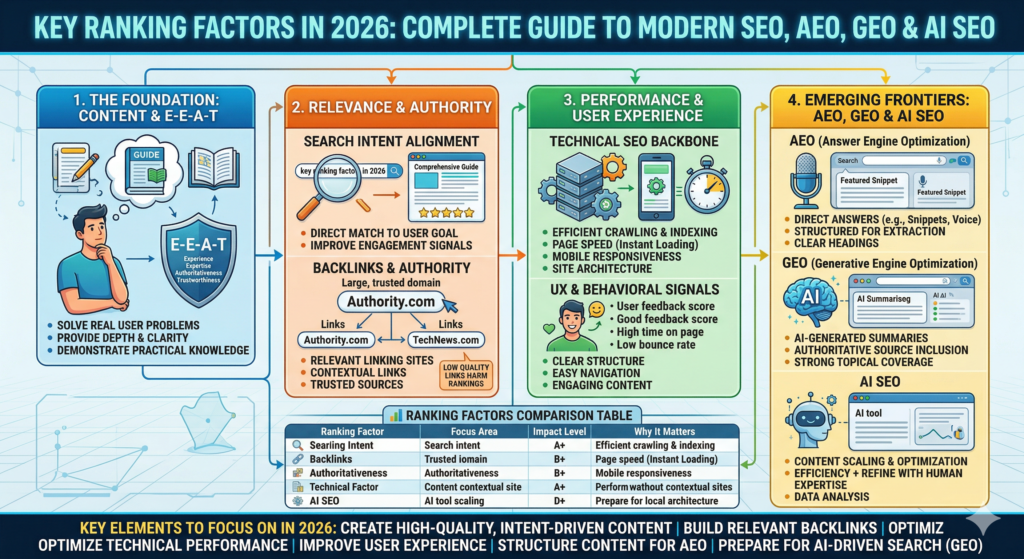
Key Ranking Factors in 2026: Complete Guide to Modern SEO, AEO, GEO & AI SEO
Introduction
Understanding the key ranking factors in 2026 is essential if you want to stay ahead. This guide will break down the most important factors that influence rankings today and explain how they connect to the future of search.
Search engine optimization has evolved far beyond traditional practices like keyword stuffing and basic backlinks. In 2026, ranking on Google is no longer just about optimizing pages — it is about understanding how search engines interpret content, user behavior, and even AI-generated answers.
If you look at how search results are changing, you will notice a clear shift. Search engines are no longer just listing websites; they are directly answering questions, generating summaries, and prioritizing highly relevant content. This transformation has introduced new concepts such as Answer Engine Optimization (AEO), Generative Engine Optimization (GEO), and AI-driven SEO strategies.
Quick Overview of Key Ranking Factors in 2026
Before diving deeper, here are the most important ranking factors:
- Content quality and E-E-A-T
- Search intent alignment
- Backlinks and authority
- Technical SEO performance
- User experience and engagement
- AEO (featured snippets & voice search)
- GEO (AI-generated search results)
- AI SEO (content creation & optimization)
These factors work together as a system rather than independently.
Ranking Factors Comparison Table
| Ranking Factor | Focus Area | Impact Level | Why It Matters |
| Content Quality | Value & depth | Very High | Core ranking driver |
| Search Intent | Relevance | Very High | Matches user needs |
| Backlinks | Authority | High | Builds trust |
| Technical SEO | Performance | High | Enables crawling/indexing |
| UX Signals | User behavior | High | Reflects satisfaction |
| AEO | Direct answers | Growing | Featured snippets & voice |
| GEO | AI search visibility | Emerging | AI-generated results |
| AI SEO | Content scaling | Growing | Efficiency + optimization |
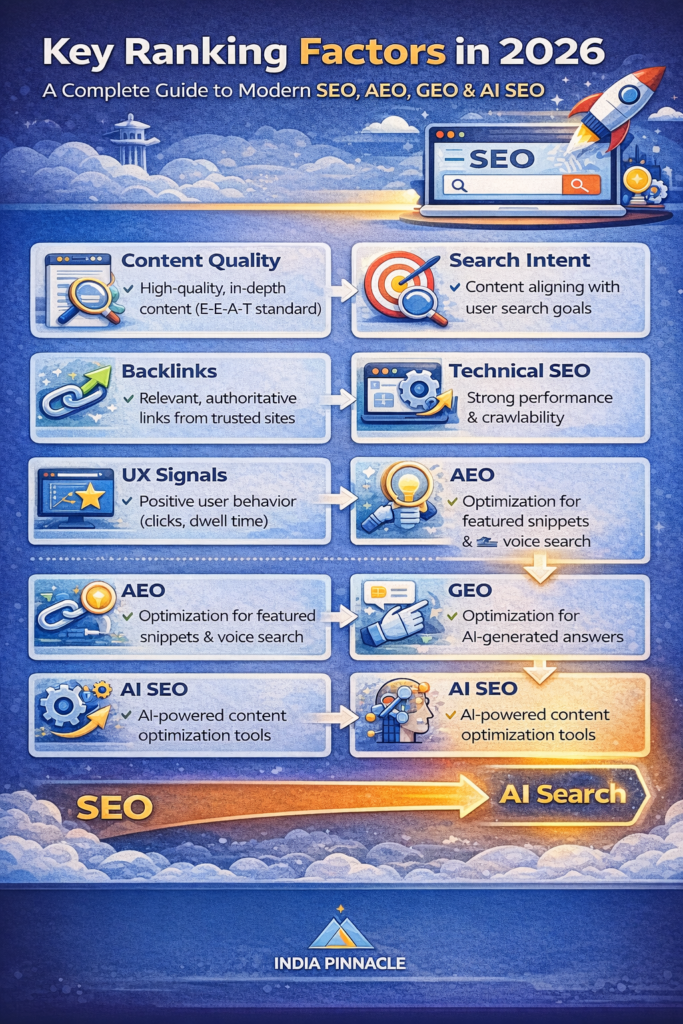
Content Quality and E-E-A-T as the Foundation
Content remains the strongest ranking factor, but its definition has evolved. In 2026, content quality is measured through E-E-A-T — Experience, Expertise, Authoritativeness, and Trustworthiness.
Search engines evaluate whether your content demonstrates real understanding and practical knowledge. Generic content written only for rankings no longer performs well.
To meet this standard, your content must:
- Solve real user problems
- Provide depth and clarity
- Reflect expertise in the subject
This is why your current content strategy — building clusters and deep guides — is aligned with modern ranking systems.
Search Intent as the Core of Relevance
Understanding search intent is critical when analyzing key ranking factors in 2026.
Search engines prioritize content that directly matches what the user is trying to achieve. This means your content must align with the purpose behind the query, not just the keyword itself.
For example, a search for “key ranking factors in 2026” expects a comprehensive and updated guide. If your content fails to meet that expectation, it will not rank effectively.
Intent-driven content performs better because it satisfies users, which improves engagement signals.
Backlinks and Authority Still Matter
Despite the rise of AI and new ranking systems, backlinks remain a strong authority signal.
However, the approach has changed. Search engines now evaluate:
- Relevance of the linking site
- Context of the link
- Overall authority of the domain
Spammy or low-quality links can harm your rankings. On the other hand, high-quality backlinks from trusted sources significantly boost your credibility.
Backlinks work best when combined with strong content. Without valuable content, even good links may not produce long-term results.
Technical SEO as the Backbone
Technical SEO ensures that your website can be properly crawled, indexed, and understood.
Even if your content is excellent, technical issues can prevent it from ranking. Factors such as page speed, mobile responsiveness, and clean site architecture directly influence performance.
This connects to how search engines work. If your pages cannot be accessed or processed efficiently, they will struggle to appear in search results.
Technical SEO does not directly attract users, but it enables everything else to function effectively.
User Experience and Behavioral Signals
User experience has become one of the most influential ranking factors.
Search engines analyze how users interact with your content. Metrics such as time on page, click-through rate, and engagement levels help determine whether your content is valuable.
If users quickly leave your page, it signals dissatisfaction. If they stay, read, and explore further, it signals quality.
Improving user experience involves:
- Clear structure
- Easy navigation
- Engaging content
These factors indirectly influence rankings by improving behavioral signals.
AEO (Answer Engine Optimization) and Featured Visibility
AEO focuses on optimizing content to appear as direct answers in search results.
This includes:
- Featured snippets
- Voice search responses
- “People Also Ask” sections
Search engines are increasingly providing answers directly, reducing the need for users to click on links. This means your content must be structured in a way that can be easily extracted and displayed.
Using clear headings, concise explanations, and structured formats increases your chances of appearing in these positions.
GEO (Generative Engine Optimization) and AI Search
GEO is one of the most important emerging concepts in modern SEO.
With AI-driven search experiences, such as generative search results, search engines create summaries based on multiple sources. Your content must be strong enough to be included in these summaries.
This requires:
- High-quality, authoritative content
- Clear structure
- Strong topical coverage
GEO focuses on making your content “AI-readable” and trustworthy.
AI SEO and Content Evolution
AI is transforming how content is created and optimized.
AI tools can help scale content production, analyze data, and improve efficiency. However, relying entirely on AI-generated content without human refinement can lead to low-quality output.
The most effective strategy is combining AI with human expertise. This ensures content remains accurate, valuable, and aligned with user intent.
AI SEO is not about replacing humans — it is about enhancing productivity while maintaining quality.
Key Elements to Focus on in 2026
To simplify, here are the most actionable elements you should focus on:
- Create high-quality, intent-driven content
- Build relevant backlinks
- Optimize technical performance
- Improve user experience
- Structure content for AEO
- Prepare content for AI-driven search (GEO)
Focusing on these areas will help you stay competitive.
Conclusion
The key ranking factors in 2026 reflect a major shift in how search engines operate. SEO is no longer just about optimizing pages — it is about creating a complete ecosystem that combines content, authority, performance, and user experience.
With the rise of AEO, GEO, and AI SEO, the future of search is becoming more intelligent and user-focused. Websites that adapt to these changes will have a significant advantage.
Instead of chasing outdated tactics, focus on building a strong foundation and evolving with the search landscape. This is the approach that leads to sustainable rankings.
FAQs
What are the most important ranking factors in 2026?
Content quality, search intent, backlinks, technical SEO, and user experience are the most important factors.
What is AEO in SEO?
AEO focuses on optimizing content for direct answers like featured snippets and voice search.
What is GEO in SEO?
GEO is about optimizing content for AI-generated search results and summaries.
Want your website optimized for modern SEO and AI-driven search?